CHIEF EXECUTIVE
OFFICER’S FOREWORD
I am pleased to present the Perishable Products Export Control Board’s (PPECB’s) annual report for 2024/2025.
The report highlights the progress we have made against our medium-term strategy to create further efficiencies and effectively respond to challenges faced by the sector. It also highlights the operational achievements for the period under review.
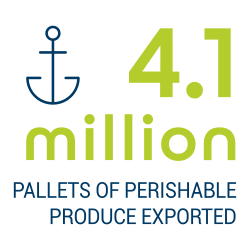
While the logistical challenges in major South African ports remain a concern, there was certainly a marked improvement compared to the previous year’s performance. Ageing infrastructure continues to be a significant stumbling block, though it has been somewhat mitigated through close collaboration between major stakeholders to ensure the flow of cargo. The mid-summer drought in some areas also impacted the sector, which ultimately led to reduced production of major crops. Notwithstanding these challenges, the agricultural sector remained resilient and managed to export 4.1 million pallets of perishable produce, representing an overall growth of 7.5% against the previous reporting period.
LUCIEN JANSEN
Chief Executive Officer
PPECB
Improved customer experience remains one of the PPECB’s major focus areas. During the period under review, we continued to measure customer satisfaction as a key performance indicator and addressed the areas where we can improve. I am delighted to report that we received a customer satisfaction rating of 90% during 2024/2025, which is in line with the satisfaction rating of the previous year.
In addition, Electronic Consignment Reports were introduced in 2024, where the PPECB now provides clients with electronically signed and stamped consignment reports. TITAN 2.0® also fully integrates with eCert’s Tracking Unit Manager (TUM) version 3, deployed in November 2024. These additions and improvements are targeted to significantly increase efficiencies and ultimately reduce costs for the sector.
Overall, export volumes of perishable produce remained steady at 4.1 million pallets. Europe remains the biggest export market for South African fresh produce, with 36% of produce exported to this region. Asia took 15%, the Middle East 15%, Russia 7% and America 7%. Exports to Europe remained stable, with a steady increase to the Middle East when compared to the previous year.
The year under review also saw the publication of the revised Perishable Products Export Control (PPEC) regulations. The regulations were published in January 2025 and will come into effect on 18 July 2025. The revised regulations are intended to streamline processes and further promote the orderly export of perishable produce.
The PPECB research and development (R&D) unit was very busy during 2024/2025. The R&D model is based on collaboration with industry stakeholders to ensure that critical issues are addressed. To this end, initiatives for the year under review included, but are not limited to, studies with regards to temperature control during rail transport and temperature management during the handling of citrus, plums and blueberries. The PPECB also finalised and printed its first Research and Innovation Journal, which documents trials and research activities conducted between 2022 and 2023. This comprehensive publication resulted from a long-term, collaborative effort and now serves as a strategic platform for industry stakeholders to access and engage with the PPECB’s research outputs. Distribution of printed copies to industry bodies has commenced and has been met with positive feedback.
Environmental, Social and Governance (ESG) has been a topical issue globally. During the year under review, the PPECB continued its ESG journey, completing assessments and workshops that will inform the organisation’s ESG strategy set to be completed in the latter part of 2025.
The PPECB remains committed to forging even stronger relationships with stakeholders and adding greater value to clients and their businesses. We wish to thank stakeholders for their support and understanding during the past year. I also extend my gratitude to the Board, the Department of Agriculture (DoA) and colleagues for their guidance, support and commitment. All the best for the year ahead!