

Information and
Communications
Technology Report
Bridgette Daries
Chief Information Officer
PPECB
In September 2024, Bridgette Daries joined the Perishable Products Export Control Board (PPECB) as the Chief Information Officer (CIO), where she and her leadership team assessed the PPECB’s Information and Communications Technology (ICT) Strategy.It was evident that the 2024/2025 financial year marked a significant year in the PPECB’s digital transformation journey, which commenced five years ago. The journey required significant time, financial investment and change management while maintaining customer service and service delivery.
- Enhance customer service and service delivery;
- Accelerate the delivery of high-value business-enabling projects;
- Create collaborative business relationships;
- Optimise business processes; and
- Ensure we achieve a return on our ICT investment.
We are pleased to report that the ERP system, which went live in the previous financial year, has now stabilised and transitioned to a business-as-usual operating model, supported by the ICT department. Critical system functionality within our value chain continues to be delivered via our TITAN 2.0® platform, a key enabler along the export value chain.
Significant progress has also been made in the integration of our systems, including our Master Data System (MDS). This has led to improved data quality and availability, with information being delivered to customers and partners in a timely manner via multiple platforms, including our INTELLEX online reporting platform.
Collaboration and integration with external stakeholders have also been crucial, contributing to further digitalisation of the agricultural industry. These efforts have enhanced processes, increased efficiencies and provided business insights across the value chain.
The delivery of these strategic ICT deliverables – including maintaining our infrastructure and development environments on the latest technology – ensures that the ICT department is delivering on the PPECB’s vision of being a customer-centric regulator and enabler. This is underpinned by the availability of the right skills and talent within our operating model, which is supported by reliable partners and governed by stringent security measures and cost controls.
Bridgette Daries
Chief Information Officer
PPECB
Enabling The Value Chain
Stakeholder Engagement
Stakeholder Universe – Increase Year On year
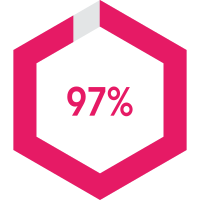
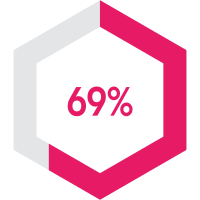
The diagram below depicts the year-on-year percentage improvements in the digitisation of each of the PPECB’s core processes. Notable increases include a 1% rise in Product Inspection, a 46% increase in Product Re-inspection, a 6% increase in Electronic Export Certificates, an impressive 87% increase in Export Notification and a 60% increase in Container Inspection.
Inspection
1% increase
Re-Inspection
46% increase

Certificates
6% increase

Notification
87% increase

Inspection
60% increase
Titan 2.0®
In the previous financial year, the container loading module, including the loading and vessel loading mobile applications, was deployed, with further functionality scheduled for release early in the new financial year.
The Electronic Consignment Report has also been digitised, ensuring that the PPECB maintains full control over the information generated on the document and that the inspectors electronically stamp and sign the consignment note and are able, with appropriate role-based access, to view and download electronic consignments.
The integration of TITAN 2.0® into the DoA’s Tracking Unit Manager (TUM) version 3 was also completed.
The rewrite and release of the TITAN 2.0® authorisation method, namely Organisational Linking, provides functionality for financial transaction amendments across the various TITAN 2.0® modules. This functionality is currently under development, with phased releases planned for the new financial year. While the ongoing focus is on adding other modules to TITAN 2.0®, the continued stability, resilience, scalability, security, and integrity of the TITAN 2.0® systems remain fundamental.
To support this, framework upgrades have been implemented for the APIs and mobile applications, with Web upgrades scheduled to go live in the first quarter. Single Sign-On (SSO) and Multi-Factor Authentication (MFA) have been implemented on the mobile applications, and the same security measures are planned for TITAN 2.0® Web in the first quarter.
In addition, TITAN 2.0® has commissioned Azure B2C instance to centralise system authentication for PPECB customers. This enables users to access all client-facing systems – such as TITAN 2.0®, ERP Customer Portal, and INTELLEX – using the same User ID and password, thus improving the customer experience.
Microsoft Dynamics 365 (D365)
During the last financial year, the focus was on automating the billing process for TITAN 2.0® to minimise delays between services being rendered and invoices being issued. Several enhancements were also made to the invoice and statement layouts based on customer feedback. Where manual capturing is still required, the capturing screens were streamlined to simplify the process for administrative users in Operations, thereby reducing errors and speeding up capturing times.
The ERP is continuously updated in line with Microsoft’s upgrade schedule. To minimise risk, the PPECB remains one version behind the latest release, allowing time for any bugs or issues to be resolved before implementation. By implementing updates regularly, the PPECB ensures access to ongoing improvements and enhancements made by Microsoft to the D365 platform.
Business Intelligence
Significant technological improvements have been made in data sourcing, to facilitate more timely data availability. The PPECB has invested in advanced data integration tools, allowing access to information from different applications across the organisational landscape.
Data quality is taken seriously. Established data governance forums help identify and manage anomalies, with data role players taking ownership to ensure the master data is well-defined, centrally maintained and accessible to all subscribing applications. The consistent application of master data across systems is showing positive results for both internal and external reporting.
The Data and Analytics team is staying updated with future concepts and new technologies. An Artificial Intelligence (AI) Request for Information (RFI) process has highlighted the possibilities of AI and Robotic Process Automation (RPA), revealing exciting opportunities for improving data availability and generating deeper insights for the PPECB. In collaboration with Microsoft and other partners, the PPECB has worked with graduates skilled in AI and Data Science to further explore these possibilities.
Throughout the reporting period, the Data and Analytics team has worked closely with stakeholders to facilitate their digital journeys – providing insights to aid seasonal planning, assess port congestion, evaluate the impact of adverse weather, and navigate geopolitical and trade-related challenges affecting global trends.
Strong Fundamentals
The enablement of the value chain, as described above, is made possible by the robust ICT foundations the PPECB has established and continues to strengthen.
Governance
Risk
To ensure the integrity and security of the PPECB’s information and technology, the ICT department continues to leverage best practices from several leading local and global standards for information and system security management. As a result, the organisation reported no significant audit findings or cybersecurity incidents in the last financial year.
Key initiatives during the year included implementing several cybersecurity tools and technologies, deploying several new policies, and two successful disaster recovery (DR) tests. A Business Impact Assessment study was completed, and updates to the Business Continuity Plans (BCP) are underway. Our upgrade to Windows 11 for end-user computing is progressing well, with plans to upgrade server operating systems scheduled for the new financial year.
During the 2024/2025 financial year, several strategic outsourcing agreements for infrastructure and service delivery were successfully renewed. This has contributed to enhanced system reliability, reduced incidents, improved availability and sustained adherence to internal Service Level Agreements (SLAs), all of which support the consistent delivery of reliable inspection services to our customers.
Cost Management
The ICT department continues to monitor and control technology spend effectively, proactively identifying opportunities for cost savings and cost avoidance. Licence fees and printing costs have been reduced, partially offsetting increased storage costs.
Additionally, the ICT department has partnered with the Business Process Optimisation division in the Operations department to map end-to-end business processes. This initiative seeks to identify efficiency opportunities and optimise the way we do business, reduce manual processes, leverage existing ICT investments, and ultimately lower operational costs.
Improvements have also been made in the timely delivery of departmental cost insights supported by automation and enhanced data visibility, reducing the manual effort previously required.
Looking Ahead
- D365 Customer Engagement: A new customer portal will be introduced to facilitate the customer registration process as required by the PPEC Regulations published in January 2025. Additional functionality will be phased in for customers to log online queries and view their invoices and statements online;
- TITAN 2.0®: Continued development and deployment of fully digitised Export Certificates, Container Loading, Non-TITAN products, Organisational Linking, Transnet integration, Vessel Loading and Internal Amendments;
- Laboratory Expansion Support: ICT will partner with the PPECB Laboratory to ensure that the technology is upgraded and supports the strategic expansion goals; and
- Oracle Fusion Human Capital Management: implementation of additional modules – including Talent Management, Performance Management, Health and Safety and Work Life Solutions – will go live for end users in May 2025.
We are also advancing our employee journey with the implementation of these Oracle Fusion modules to support workforce development and wellbeing.
The Data and Analytics team is continuing the journey to convert manual data delivery into automated delivery on the available digital platforms. Further exploration regarding AI and Robotic Process Automation (RPA) is underway to improve the availability and quality of the data for reporting. Data science capabilities will be employed in specific use cases to demonstrate their value and improve insights.
We are excited to be taking over the management of the Project Management Office (PMO) for the PPECB. This will enable us to provide a framework that aligns projects with strategy and ensures their execution is in accordance with sound project management principles, thereby delivering the intended business value.
We will continue to partner with the Business Process Optimisation division to identify opportunities for process improvement across the value chain. This will ensure that we leverage technology to drive business efficiencies and support the following PPECB business objectives:
- Further improve the customer experience;
- Provide relevant and timeous information;
- Promote continuous improvement through transformation, innovation and digitalisation; and
- Improve business efficiencies to ensure effective service delivery and to contain costs.
