

Human Capital
Report
PINKI LUWACA
Human Capital Executive
PPECB
Key Highlights
This report will cover the following key areas:
- Human Capital Operations;
- Learning and Development;
- Talent Management;
- Organisational Development; and
- Transformation.
PINKI LUWACA
Human Capital Executive
PPECB
Operations
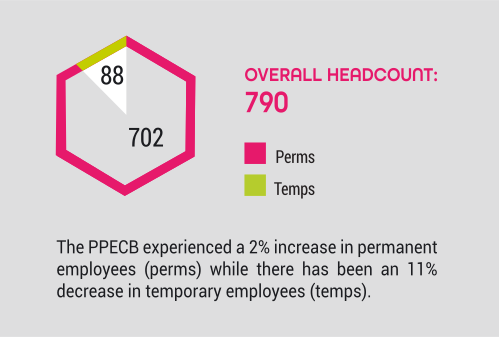
Employee Statistics:
Employee Movements

It is significantly lower than the average employee turnover rate in South Africa which is currently around 17%.

Employee Wellbeing and Benefits

Integrity
18 proactive intervention sessions
focusing on mental wellbeing took place. These included awareness, training and the provision of tools aimed at upholding integrity and equipping employees across the organisation with tips and techniques.
400 employees participated
in or attended the mental health interventions held during this reporting period.
2 external partners provided specialised expertise, resources and costeffective solutions relating to mental, social and financial matters.
10 employees per month made use of employee wellness services and the top three issues which employees were assisted with are mental wellbeing, legal and couple or family-related issues.
2 disability and critical illness claims were paid during this reporting period. This is a benefit that pays a lump sum amount when an employee is diagnosed with a critical illness.

Collaboration
27 employees accessed or made use of value-added benefits and tools such as financial planning, debt, credit and wealth management programmes, which are provided to employees in collaboration with one of our reputable financial partners.
253 employees made contact with the contracted financial advisors.
Health and Safety
Nine employees got injured while on duty during this reporting period. They all received the necessary medical treatment and subsequently returned to work. No major incidents or fatalities occurred.
The Learning and Development team undertook a significant initiative to ensure that all newly appointed Health and Safety Representatives received the training required by legal and regulatory obligations.
Please see the table below for more details:
| Course Name | No of Employees Trained |
|---|---|
| SHE Representative | 27 |
| First Aid | 18 |
| Fire Marshall | 22 |
| Legal Liability | 38 |
| COIDA | 46 |
| HIRA | 24 |
Learning and Development
Employees and managers were trained on how to use the learning module and enabled to electronically submit their development needs, as well as applications for study assistance for academic qualifications.
A total of 534 employees received training during the reporting period, with 27 training courses procured. Key training initiatives included:
- 28 employees successfully completed the Leadership Development Programme (LDP) aimed at strengthening leadership capabilities and developing a pipeline of potential leadership talent for the PPECB;
- Assessor and Moderator training programmes were delivered at scale to equip relevant Operations employees with the competencies required to assess and moderate training evidence;
- Managers were enrolled on a two-day industrial relations (IR) intervention, and additional training in report-writing skills was also provided; and
- Extensive training was conducted to ensure the competency of Health and Safety Representatives (SHE Reps) and Firefighters. This included modules on Hazard Identification and Risk Assessment (HIRA) and the Compensation for Occupational Injuries and Diseases Act (COIDA).
In support of academic advancement, 23 employees were awarded study assistance to commence formal qualifications, while nine employees received continued support to pursue their studies. Additionally, six employees received AgriSETA bursaries.
The L&D department continued to provide workplace experience initiatives to unemployed graduates. Through the Agri Export Technologist Programme (AETP), 53 disadvantaged agricultural graduates gained practical exposure and training. Furthermore, nine unemployed graduates were placed in experiential learning opportunities within the Laboratory, Human Capital, and Project Management Office departments. Of these, four completed their placements, and two were subsequently absorbed on contract.
Training manuals, courses and plans were developed to provide training support to the ERP, TITAN 2.0® and MyHC project teams.
Notable achievements for the period included an improvement in the Skills Development rating, contributing to the PPECB’s overall B-BBEE scorecard, as well as the initiation of the transition process to align the AETP’s NQF qualification with the updated national quality framework.
Talent Management
Awareness sessions were conducted with employees and managers on future career growth planning and how this will be reflected within the new MyHC system.
The Career Development, Talent Review, and Succession Planning modules were configured on MyHC. Training on these modules is scheduled to commence in April 2025.
In preparation for the annual 2025 Talent Reviews, Human Capital is finalising plans to implement the new MyHC-enabled talent review process set to launch in May 2025.
- A total of 18 employees were selected to participate in the Operations Supervisory Talent Development programme (Acting Lead Assessors and Chief Inspectors). Delegates receive customised development plans and on-the-job learning experiences during these acting opportunities;
- 28 employees were enrolled in the current intake of the Leadership Development Programme (LDP) NQF Level 4 and NQF Level 5. Learners receive personal developmental feedback and individual coaching as part of this programme;
- A renewed training subscription was secured for the ICT department to support career growth and aid the retention of project-based employees with specialised skills; and
- Six custom Talent Development and Retention opportunities for critical competencies were implemented to address critical skill needs across the organisation. These initiatives offer selected employees structured exposure to business-critical competencies through shadowing, mentoring, and participation in management and stakeholder meetings, thereby supporting meaningful professional growth and organisational knowledge transfer.
The outcomes and insights gained from these programmes will feed into the 2025 Talent Review forums, leveraging the full functionality of the newly implemented MyHC Talent Management modules.
ORGANISATIONAL DEVELOPMENT
DIGITAL TRANSFORMATION, CULTURE AND ENGAGEMENT
EMPLOYMENT EQUITY
Male | Female | Foreign nationals | |||||||||
|---|---|---|---|---|---|---|---|---|---|---|---|
| PPECB ALL: ACTUAL 31 MARCH 2025 | A | C | I | W | A | C | I | W | Male | Female | Total |
| Top management | 0 | 1 | 0 | 0 | 0 | 0 | 0 | 0 | 0 | 0 | 1 |
| Senior management | 0 | 1 | 0 | 1 | 1 | 1 | 0 | 0 | 0 | 0 | 4 |
| Professionally qualified and experienced specialists and mid-management | 9 | 5 | 3 | 5 | 3 | 5 | 2 | 5 | 0 | 0 | 37 |
| Skilled technical and academically qualified workers, junior management, supervisors, forepersons, and superintendents | 135 | 50 | 8 | 35 | 141 | 25 | 5 | 7 | 0 | 0 | 406 |
| Semi-skilled and discretionary decision making | 57 | 38 | 17 | 2 | 80 | 31 | 6 | 5 | 0 | 0 | 236 |
| Unskilled and defined decision making | 0 | 0 | 0 | 0 | 12 | 6 | 0 | 0 | 0 | 0 | 18 |
| TOTAL PERMANENT | 201 | 95 | 28 | 43 | 237 | 68 | 13 | 17 | 0 | 0 | 702 |
| Temporary employees | 13 | 14 | 1 | 2 | 45 | 11 | 1 | 1 | 0 | 0 | 88 |
| TOTAL | 214 | 109 | 29 | 45 | 282 | 79 | 14 | 18 | 0 | 0 | 790 |
A key area for improvement remains the increased representation of African males, which will be addressed through targeted recruitment and promotional opportunities. Similarly, advancing African females at the professional level remains a strategic
MARCH 2025
Male | Female | Foreign nationals | |||||||||
|---|---|---|---|---|---|---|---|---|---|---|---|
| Occupational levels | A | C | I | W | A | C | I | W | Male | Female | Total |
| Top management | 0 | 0 | 0 | 0 | 0 | 0 | 0 | 0 | 0 | 0 | 0 |
| Senior management | 0 | 0 | 0 | 0 | 0 | 0 | 0 | 0 | 0 | 0 | 0 |
| Professionally qualified and experienced specialists and mid-management | 0 | 1 | 0 | 0 | 0 | 1 | 0 | 0 | 0 | 0 | 2 |
| Skilled technical and academically qualified workers, junior management, supervisors, forepersons, and superintendents | 1 | 0 | 1 | 0 | 1 | 0 | 0 | 0 | 0 | 0 | 3 |
| Semi-skilled and discretionary decision making | 1 | 0 | 0 | 0 | 2 | 0 | 0 | 0 | 0 | 0 | 3 |
| Unskilled and defined decision making | 0 | 0 | 0 | 0 | 0 | 0 | 0 | 0 | 0 | 0 | 0 |
| TOTAL PERMANENT | 2 | 1 | 1 | 0 | 3 | 1 | 0 | 0 | 0 | 0 | 8 |
| Temporary employees | 0 | 0 | 0 | 0 | 1 | 0 | 0 | 0 | 0 | 0 | 1 |
| TOTAL | 2 | 1 | 1 | 0 | 4 | 1 | 0 | 0 | 0 | 0 | 9 |
TRANSFORMATION
The PPECB’s transformation strategy focuses on building lasting partnerships with organisations that are driving meaningful change in the industry.
Typically, these are emerging producers with an annual turnover of up to R5 million, aspiring to scale from subsistence to commercial farming.
The PPECB’s Smallholder Farmer Development Programme is dedicated to training and upskilling smallholder farmers from designated groups to support their transition from subsistence to commercial farming.
- SAGAP training workshops for 839 smallholder farmers have been conducted year to date. The annual target was surpassed due to provinces expanding their programmes and an increase in demand for certification from the market; and
- 134 producers of raisins, rooibos, vegetables, nuts and fruit were certified for export.
The PPECB implemented training for three new cohorts of Black youth, men and women in the Eastern Cape, Gauteng and Mpumalanga provinces. Delivered under the Agri Academy, this three-year market access programme empowers 60 delegates to develop comprehensive business plans and receive coaching toward successful implementation. The participant farmers were selected in conjunction with input from the provincial departments of agriculture.
Corporate Social Investment
These initiatives extend beyond the organisation’s core operations and are not profit-driven. They represent a commitment to contributing meaningfully – both financially and in kind – to initiatives that improve the lives of South Africans.
| Partnership - Social Enterprise Development/CSI |  Call 2 Care |  Soil for Life |  Reel Life |  Recruit Agri |
|---|---|---|---|---|
| What they do | Provides education in communities at the grassroots level in waterwise gardening, food security and improved nutrition. | Encourages local home food growing, natural food growing methods and training methodologies to achieve food security. | Provides sustainable and scalable solutions to food, nutrition and economic inclusion challenges in South African communities and households. | Encourages entrepreneurship and empowers graduates in agriculture through an internship programme that improves employment opportunities. The programme covers five provinces, with the largest intake in the North. Products covered include avocado, macadamia nuts, kiwi fruit, berries and citrus. |
| Spend as at March 2025 | R216 776.87 | R252 075.20 | R470 924.64 | R157 470.00 |
| Beneficiaries | 17 people trained and 30 direct beneficiaries - one community | 40 people trained and 1 683 direct beneficiaries - four rural communities | 248 learners trained, 200 households, two subsistence farmers and 450 direct beneficiaries - two rural communities | Training for 15 graduates |
| Impact | Establishment of a food garden, youth training in food gardening and introduction of waste management training. Diepsloot Combined School community garden (youth and vulnerable families) | Establishment of a food garden and youth training in food gardening. Wes-Eind Primary School and Dalubuhle Primary School, Franschhoek (youth) Struisbaai Skills Centre & Agulhas School of Skills (youth) Establishment | Establishment of household food gardens and training of rural women in food gardening. Kromdraai Community, Krugersdorp (youth, vulnerable families and women) Dikhudu Primary School and Lefoko Primary School, Zeerust (youth) | Training for processing graduates in practical on-farm production, packhouses and agroprocessing. Subtrop processing programme - Mpumalanga (youth) |
THE ROAD AHEAD
The Human Capital department remains committed to advancing the PPECB people agenda, ensuring that the organisation’s strategic goals and objectives are fully supported through a capable, engaged and empowered workforce.
Our focus will continue to centre on a high-performance culture, deepening employee engagement and developing and growing the next generation of leaders. We will also maintain our momentum in driving transformation, with particular emphasis on youth development and the empowerment of women.